
Bilingual EAs: The Secret to Solving the Labor Shortage
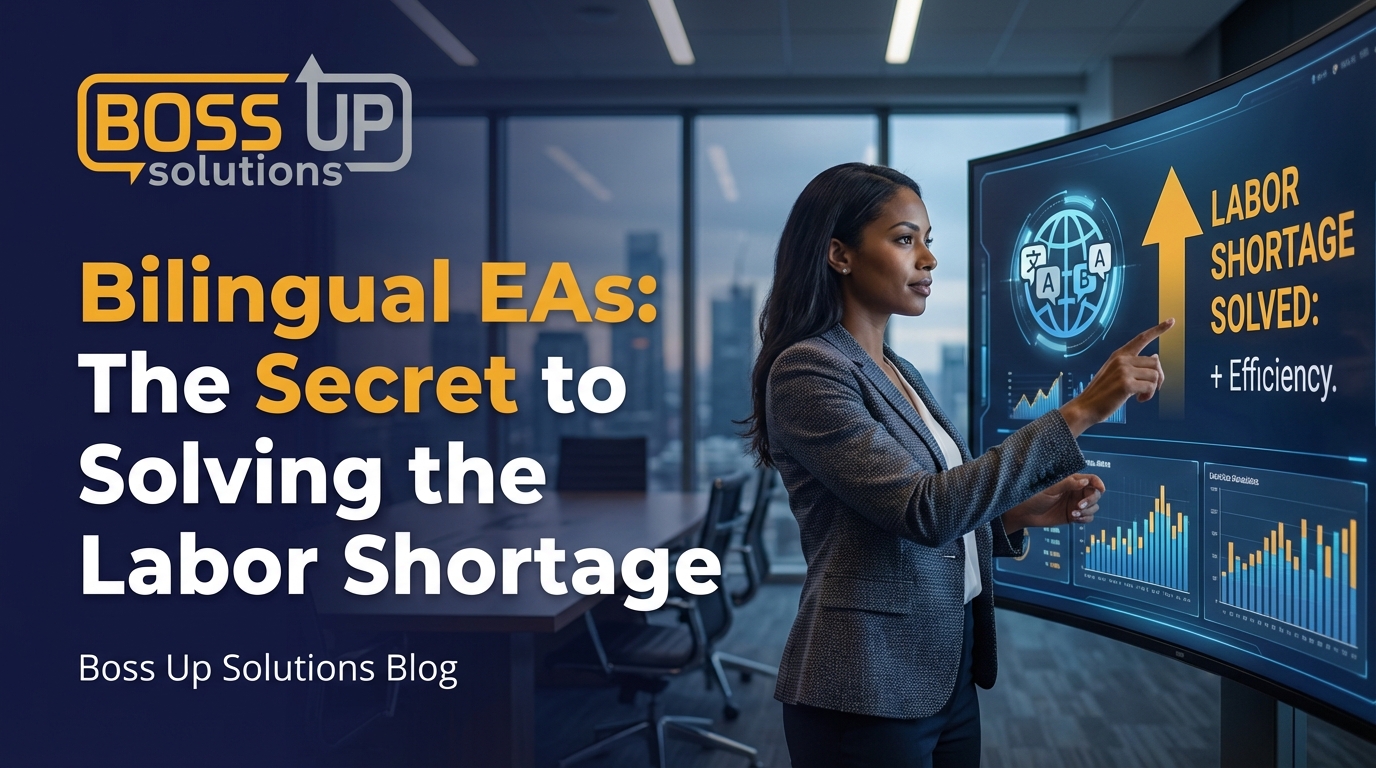
Bilingual EAs: The Secret to Solving the Labor Shortage
The American labor market has fundamentally changed, and for business owners in high-demand sectors like roofing, insurance restoration, and public adjusting, the impact is undeniable. You are likely facing a brutal reality: good help isn't just hard to find; it is becoming prohibitively expensive and increasingly unreliable. The "Great Resignation" may have faded from the headlines, but its aftershocks are still rattling small and mid-sized businesses. You post a job ad, and you get silence—or worse, hundreds of unqualified applicants who ghost you before the first interview.
If you are trying to scale your operation while drowning in administrative chaos, you cannot afford to wait for the domestic labor market to correct itself. The traditional model of hiring a local, in-office administrative assistant is broken for many growing firms. The costs are too high, the talent pool is too shallow, and the flexibility is non-existent. But there is a solution that forward-thinking entrepreneurs are leveraging to bypass these hurdles entirely.
Enter the Bilingual Executive Assistant (EA). By looking beyond immediate geographic borders and tapping into the nearshore talent pool of Latin America, you can secure highly educated, motivated, and bilingual professionals who do more than just answer phones. They become the operational backbone of your business, bridging language gaps with crews and customers while handling the heavy lifting of back-office management. This isn't just outsourcing; it's a strategic upgrade.
The Solution: Why Bilingual EAs Are the Missing Link
The Secret to Solving the Labor Shortage: Bilingual Virtual Executive Assistants (EAs) from Latin America provide a dual-threat solution to the US labor crisis. They offer cost efficiency (saving 50-70% compared to domestic hires) and operational agility by bridging communication gaps between English-speaking management and Spanish-speaking field crews or customers. Unlike general virtual assistants, specialized Bilingual EAs operate in US time zones, possess high-level degrees, and manage complex workflows—from CRM management to logistics—allowing business owners to scale without the overhead of W-2 employees.
The Hidden Cost of the Labor Shortage
For contractors and adjusters, the labor shortage isn't just an inconvenience; it is a direct threat to revenue. Every hour you spend scheduling appointments, chasing down material orders, or responding to routine emails is an hour you are not inspecting roofs, negotiating claims, or closing deals. The opportunity cost of administrative drag is massive. When you are forced to wear the hat of an office manager, your high-value skills are wasted on low-value tasks.
Furthermore, the cost of acquiring domestic talent has skyrocketed. To hire a competent, experienced Executive Assistant in the United States today, you are looking at a base salary that can easily exceed $60,000 to $80,000 annually in major markets. That number doesn't even include the "hidden" costs of employment: payroll taxes, health benefits, paid time off, 401(k) contributions, and the physical overhead of office space and equipment. When you tally it all up, that $60k employee actually costs your business closer to $85k or $90k.
The shortage is also qualitative. Finding candidates with the specific mix of grit, organizational skills, and industry knowledge required for the fast-paced restoration environment is like finding a needle in a haystack. Many domestic applicants demand remote work flexibility but lack the discipline to execute it effectively. This leaves business owners in a cycle of hiring, training, and firing that drains morale and halts growth. You need a stable, long-term solution, not a stop-gap measure.
The Evolution of the Executive Assistant Role
Gone are the days when an Executive Assistant was simply a gatekeeper who fetched coffee and took messages. The role has evolved into a strategic partnership. Modern EAs are project managers, operational coordinators, and trusted confidants who understand the inner workings of the business. In a remote-first world, the physical location of this partner is irrelevant compared to their capability, availability, and connectivity.
This evolution is particularly relevant for the construction and insurance industries. Your "office" is often a truck or a job site. You function digitally, using cloud-based tools like JobNimbus, AccuLynx, Xactimate, and CompanyCam. An EA who can navigate these platforms proficiently is infinitely more valuable than someone who simply sits at a front desk greeting walk-ins. The modern EA manages your digital ecosystem, ensuring that data flows correctly from the field to the office and back again.
Virtual EAs have stepped into this void, offering a level of specialization that generalist local hires often lack. They are accustomed to remote workflows, utilizing tools like Slack, Zoom, and Asana to maintain constant communication. They understand that their value is measured by their output and their ability to buy back the business owner's time. This shift from "presence-based" employment to "performance-based" partnership is the key to scaling in the current economy.
Why Bilingual? Unlocking the Power of Dual-Language Support
For the roofing and restoration industry, the "Bilingual" aspect of these EAs is not just a nice-to-have bonus; it is a critical operational asset. The reality of the construction labor force in the United States is that a significant portion of field crews and subcontractors are Spanish speakers. Miscommunication between English-speaking project managers and Spanish-speaking crews is a leading cause of errors, delays, and wasted materials. These mistakes eat directly into your profit margins.
A Bilingual EA acts as the bridge. They can call a crew foreman to clarify instructions, verify material drop-offs, or resolve scheduling conflicts in the foreman's native language. This eliminates the game of "telephone" that often happens on job sites and ensures that your standards are communicated clearly and effectively. It empowers your crews and respects their preferred mode of communication, which builds loyalty and efficiency.
On the flip side, the Hispanic homeowner market is a massive, growing demographic. If your office cannot effectively communicate with Spanish-speaking customers, you are leaving money on the table. A Bilingual EA allows you to market to and serve this demographic with confidence. They can handle intake calls, explain the claims process, and walk homeowners through contracts in Spanish. This capability instantly expands your total addressable market and differentiates your brand from competitors who are language-locked.
The Nearshore Solution: Why LatAm is the Key
When business owners think of "outsourcing," they often picture call centers in the Philippines or India. While those regions have their strengths, they present significant challenges regarding time zones and cultural barriers. This is where the "Nearshore" advantage of Latin America (LatAm) becomes a game-changer. Countries like Colombia, Mexico, and Costa Rica share US time zones (Central, Eastern, and Pacific), meaning your EA is online when you are online. There is no waiting 12 hours for a reply.
Cultural affinity is another major factor. Professionals in LatAm often grow up consuming Western media and are culturally aligned with US business practices. The communication style is direct, warm, and service-oriented, which resonates well with US clients and partners. This reduces the friction often felt when outsourcing to regions with vastly different cultural norms. You don't have to spend weeks teaching them how to interact with an American homeowner; the baseline understanding is already there.
Furthermore, the education level of the talent pool in major LatAm cities is impressive. Many of the Bilingual EAs sourced by agencies like Boss Up Solutions hold university degrees in business administration, engineering, architecture, or marketing. You are not hiring unskilled labor; you are hiring professionals who happen to live in a different country. They view working for a US company as a prestigious career path, which results in lower turnover and higher dedication compared to entry-level US employees.
Financial Impact: ROI and Cost Savings Analysis
Let's talk numbers, because as a business owner, the bottom line is your ultimate scorecard. The arbitrage opportunity between the US dollar and LatAm currencies allows you to secure top-tier talent at a fraction of the domestic cost. However, the value isn't just in the lower hourly rate; it's in the elimination of overhead.
| Cost Category | Domestic (US) In-House EA | Nearshore Bilingual Virtual EA |
|---|---|---|
| Annual Salary / Fee | $60,000 - $80,000 | $25,000 - $35,000 (Approx) |
| Payroll Taxes (FICA, etc.) | ~7.65% + State Taxes | $0 (Included in Flat Fee) |
| Benefits (Health, 401k) | $5,000 - $10,000+ | $0 (Provider handles this) |
| Equipment & Office Space | $2,000 - $5,000 / year | $0 (Remote / Bring Your Own Device) |
| Total Estimated Cost | $75,000 - $100,000+ | $25,000 - $35,000 |
The ROI is immediate. By saving $50,000+ annually on a single role, you free up capital that can be reinvested into marketing, sales, or production. More importantly, because the service is often a flat monthly fee, your cash flow becomes predictable. There are no surprise overtime costs or workers' comp claims. You are purchasing a service that delivers a result, simplifying your P&L and reducing your liability.
Consider also the cost of turnover. Replacing a US employee costs roughly 33% of their annual salary in recruitment, training, and lost productivity. When you partner with a specialized agency for Bilingual EAs, they handle the vetting and replacement process. If a fit isn't right, they swap the talent. This risk mitigation is a financial benefit that is often overlooked but critical for stability.
Beyond Admin: Strategic Advantages of Bilingual EAs
Do not make the mistake of pigeonholing your Bilingual EA into simple data entry. These professionals are capable of driving revenue-generating activities. In the context of a roofing or restoration business, a Bilingual EA can manage your entire sales pipeline. They can qualify inbound leads, ensuring that your sales reps only run appointments that are ready to buy. They can follow up on unpaid invoices, recovering cash that you might have written off.
Marketing is another area where they shine. A Bilingual EA can manage your social media presence, creating content in both English and Spanish to reach a wider audience. They can gather reviews from satisfied customers, respond to comments, and keep your digital footprint active. In a world where your reputation is your resume, having someone dedicated to reputation management is invaluable.
For those in the insurance restoration game, consider the documentation process. Your EA can organize photos in CompanyCam, draft initial supplement requests for your review, and ensure that mortgage checks are being tracked. They act as a transaction coordinator, moving the file forward so you can focus on the high-level negotiations. By delegating these "middle-skill" tasks, you effectively clone yourself, allowing your business to handle more volume without breaking.
Navigating Challenges: Security, Compliance, and Culture
It is natural to have concerns about data security and compliance when hiring internationally. How do you protect your customer lists and financial data? The answer lies in using enterprise-grade tools. Utilizing password managers like LastPass allows you to grant access to software without ever revealing the actual passwords. You can revoke access instantly with a single click. Furthermore, requiring the use of VPNs (Virtual Private Networks) ensures that their internet connection is secure, regardless of their location.
Compliance is another area where using a dedicated agency like Boss Up Solutions provides a safety net. If you were to hire a freelancer directly from a job board, you would need to navigate the complex international tax laws and labor regulations of their home country. By contracting through a US-based agency, you are engaging in a B2B transaction with an American company. The agency handles the compliance, pay, and legalities of the talent in their home country. You get an invoice, you pay it, and you write it off as a business expense. Simple.
Cultural integration is the final piece of the puzzle. To make this work, you must treat your remote EA as a core member of the team, not an outsider. Invite them to your weekly Zoom production meetings. Add them to the company Slack or WhatsApp group. When they feel part of the "tribe," their loyalty and productivity soar. The companies that fail at remote hiring are usually the ones that treat their VAs like disposable cogs rather than human assets.
How to Vett and Onboard Your Ideal Candidate
Finding the right person requires a rigorous vetting process. At Boss Up Solutions, we don't just look for "English speakers"; we look for fluency and professional proficiency. Candidates should undergo testing not just for language, but for soft skills like problem-solving, adaptability, and emotional intelligence. Can they handle an angry homeowner? Can they figure out a software glitch without calling you?
During the interview process (or when reviewing candidates presented to you), look for "coachability." Skill gaps can be closed with training, but attitude gaps are permanent. Ask questions about how they organize their day and how they prioritize conflicting tasks. Their answers will tell you if they have the executive functioning skills necessary to support a busy entrepreneur.
Onboarding should be structured. Do not just throw them into the fire on Day 1. Create a "Playbook"—a series of Loom videos or written SOPs (Standard Operating Procedures) that document how you want things done. Start with one major responsibility, like email management or calendar scheduling, and layer on more responsibilities as they master the first. This "progressive loading" prevents overwhelm and builds confidence.
Unique Value: The Boss Up Integration Framework
Success with a Bilingual EA isn't magic; it's a process. We recommend the "30-Day Launchpad" framework to ensure long-term success:
- Days 1-5 (The Audit): Have your EA audit your current inbox and calendar. Don't let them touch anything yet; just have them observe, tag, and categorize. This helps them learn your priorities and your "voice."
- Days 6-15 (The Handover): Hand over low-risk tasks. Let them schedule your meetings and filter spam. Implement a daily "End of Day Report" where they summarize what they did, what they need from you, and any roadblocks.
- Days 16-30 (The Expansion): Introduce them to your CRM and project management tools. Have them start communicating with external stakeholders (crews, simple customer follow-ups).
- Day 30+ (The Strategic Shift): Review the month. Identify what tasks you are still doing that they could take over. Shift their focus to revenue-support activities like lead qualification or supplement tracking.
This framework turns a remote stranger into a highly functioning executive partner in one month. It requires an initial investment of your time, but the return is a lifetime of freedom from administrative drudgery.
Conclusion: Scaling Your Business in a Tight Labor Market
The labor shortage is not going away anytime soon. The businesses that will survive and thrive in the coming years are those that adapt their hiring strategies to the new reality. Relying solely on a shrinking, expensive local talent pool is a recipe for stagnation. By embracing the nearshore model and hiring a Bilingual Executive Assistant, you are doing more than just filling a seat. You are unlocking a competitive advantage.
You are gaining a partner who works when you work, speaks the language of your workforce and your customers, and costs a fraction of a domestic hire. This is how you Boss Up. You stop complaining about the lack of good help and you go out and find the best help the world has to offer. It's time to stop bleeding cash on overhead and start investing in efficiency.
Ready to Boss Up Your Operations?
If you are ready to reclaim your time and scale your business with top-tier bilingual talent, Boss Up Solutions has your back. We specialize in connecting roofing and restoration professionals with pre-vetted, highly trained Bilingual Executive Assistants who are ready to hit the ground running. Don't let administrative chaos hold you back another day.
Click here to schedule your consultation with Boss Up Solutions today and discover how our Bilingual EAs can transform your business from the inside out.