
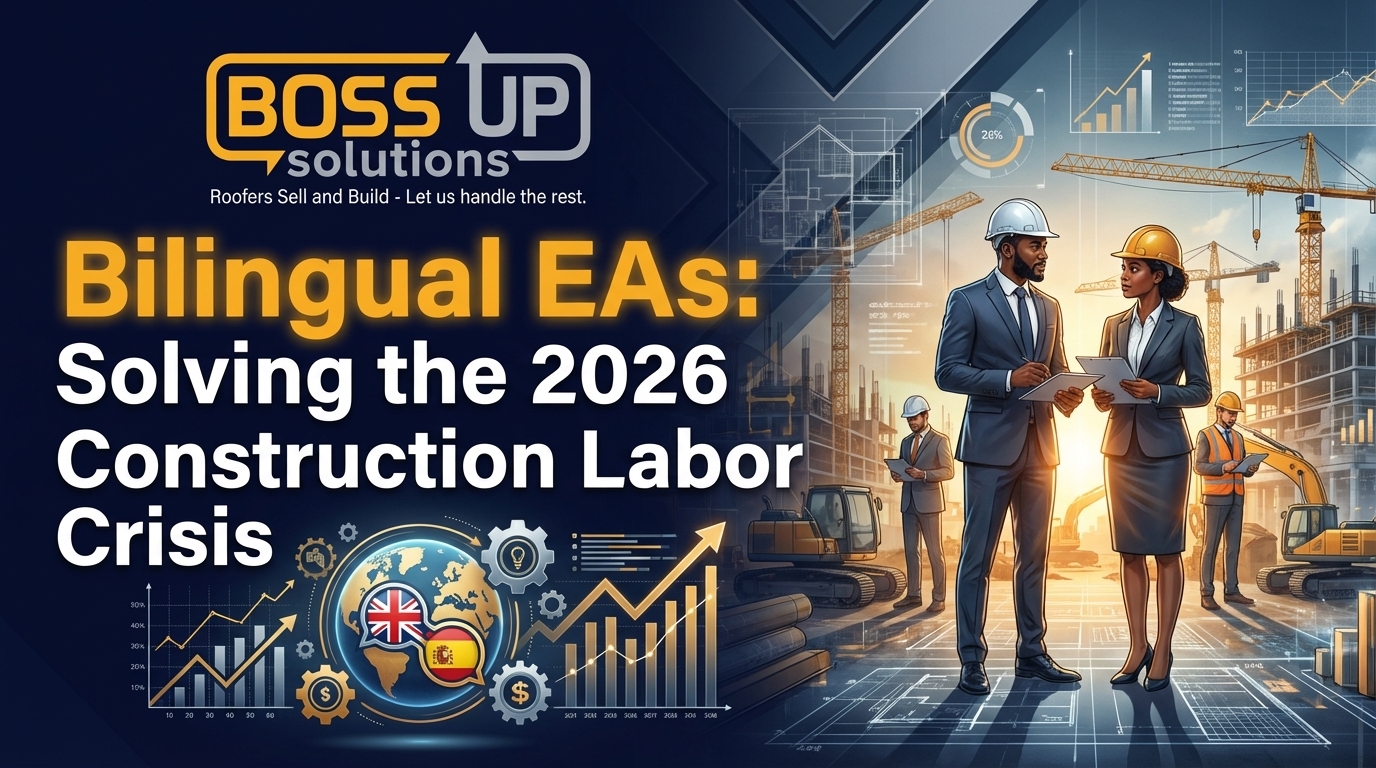
Bilingual EAs: Solving the 2026 Construction Labor Crisis
The construction industry is barreling toward a tipping point. By 2026, the gap between the volume of work available and the skilled labor required to execute it is projected to reach critical mass. For roofing contractors and restoration business owners, the old playbook of "hiring more guys" is no longer viable. Local talent is scarce, wages are skyrocketing, and your best project managers are burning out under a mountain of paperwork.
It is time to rethink your workforce strategy. The solution isn't just finding more bodies; it's about optimizing the talent you already have by integrating a strategic asset: the Bilingual Executive Assistant (EA).
How Do Bilingual EAs Solve the Labor Crisis?
Bilingual Executive Assistants solve the construction labor crisis by offloading up to 40% of administrative, non-revenue-generating workload from onsite Project Managers and Superintendents. Unlike standard virtual assistants, specialized construction EAs act as "cultural brokers," bridging the communication gap between English-speaking management and Spanish-speaking field crews. This allows your expensive onshore talent to focus entirely on production and quality control, effectively multiplying your workforce capacity without increasing local headcount.
The 2026 Construction Labor Landscape: Crisis or Opportunity?
Industry data paints a stark picture for the coming years. Associated Builders and Contractors (ABC) reports consistently highlight the need for hundreds of thousands of new workers annually to meet demand. By 2026, a significant portion of the seasoned "Baby Boomer" workforce will have retired, leaving a vacuum of experience that younger generations are not filling fast enough.
For roofing and restoration owners, this presents a binary choice: Crisis or Opportunity. Those who cling to traditional staffing models will face stalled projects, margin compression due to wage inflation, and increased error rates. Conversely, forward-thinking owners who adopt a hybrid staffing model—combining local field expertise with remote, bilingual operational support—will build a scalable infrastructure capable of dominating the market.
Why Traditional Hiring Won't Solve the 2026 Shortage
Trying to solve the 2026 problem with 2010 thinking is a recipe for failure. Here is why reliance on local hiring for administrative and coordination roles is becoming a liability:
- Wage Inflation: The cost to hire a competent local administrative assistant or junior project coordinator has surged. When you add burden rates (taxes, insurance, benefits), the overhead eats directly into your net profit.
- The "Warm Body" Problem: Desperation often leads to hiring unqualified staff just to fill a seat, resulting in training bottlenecks and eventual turnover.
- Misallocation of Talent: Perhaps the biggest tragedy is seeing a $100,000/year Project Manager spending 15 hours a week chasing permits, translating for crews, or updating CRM fields. That is an expensive secretary.
Enter the Bilingual Executive Assistant: More Than Just Admin
At Boss Up Solutions, we distinguish between a generic "Virtual Assistant" and a Bilingual Executive Assistant. The difference is strategic. A generic VA schedules appointments. A Construction EA manages operations.
These professionals are not just task-doers; they are operational partners. They understand the lifecycle of a roofing claim, the urgency of a material order, and the nuance of subcontractor negotiations. By elevating this role to an "Executive" function, you are effectively cloning the administrative capacity of your best leaders.
The "Executive" Distinction
While a standard VA might wait for instructions, an EA anticipates needs. They monitor the weather for production delays, prepare supplement documentation before the PM asks, and ensure compliance documents are filed before the deadline hits.
The Strategic Value of Bilingual Support in Construction
In the construction and roofing sectors, the language barrier is often the single greatest source of friction. It leads to rework, safety violations, and scheduling conflicts. A Bilingual EA is your solution to this friction.
Beyond Translation: The "Cultural Broker"
It is not just about translating words; it is about translating intent. A Bilingual EA acts as a cultural broker during conflict resolution:
- Negotiation: They can have nuanced conversations with subcontractors about scope changes or pricing disputes in their native language, building rapport that an English-only manager cannot.
- Safety & Compliance: They ensure that safety protocols are not just read, but understood by the crew, reducing liability.
- Retention: Subcontractors prefer working with GCs who make communication easy. A Bilingual EA makes your company the "GC of choice" for high-quality crews.
Key Responsibilities: From Field Coordination to Back-Office Ops
To prepare for 2026, you need to strip every non-essential task from your field team's plate. Here is what a Bilingual EA handles:
1. Tech Stack Integration
Your field crews might be great at roofing but terrible at software. Your EA bridges this gap. They take raw data (photos, voice notes) from the field and ensure it is correctly entered into platforms like JobNimbus, AccuLynx, or Procore. This ensures your data is clean without forcing your foreman to become a data entry clerk.
2. Administrative Relief
Handling RFIs (Requests for Information), submittals, and pulling permits are time-consuming tasks that do not require a physical presence on the roof. An EA navigates municipal portals and supplier emails to keep the job moving.
3. Schedule Management
Coordinating site visits, adjustor meetings, and material drops requires constant phone tag. An EA manages the calendar, confirms appointments, and reroutes resources when rain delays occur.
Cost Analysis: Onshore vs. Nearshore Bilingual EAs
Let’s look at the numbers. To hire a bilingual project coordinator in the US, you are likely looking at a salary of $55k-$70k plus 20-30% burden. That is an $80k+ annual investment.
Nearshore Bilingual EAs operate at a fraction of that cost, typically a flat monthly fee that includes the management overhead. There are no payroll taxes, no health insurance premiums, and no workers' comp claims. This labor arbitrage allows you to hire two EAs for the price of one local admin, doubling your support capacity instantly.
| Cost Factor | Local Hire (Onshore) | Boss Up Bilingual EA (Nearshore) |
|---|---|---|
| Annual Cost | $75,000 - $90,000 (Burdened) | Flat Fee (Significantly Lower) |
| Training Time | Weeks to Months | Pre-Vetted & Industry Ready |
| Scalability | Difficult (Hiring/Firing Laws) | Instant (Scale Up/Down) |
Case Study: How Bilingual EAs Bridge the Field-to-Office Gap
Consider "Apex Roofing," a mid-sized contractor doing $10M in revenue. Their production manager, Mike, was drowning. He spent 4 hours a day on the phone translating for crews and 2 hours at night doing paperwork. He was on the verge of quitting.
Apex hired a Bilingual EA through Boss Up Solutions. Within 30 days:
- Communication: The EA took over all scheduling calls with the sub-crews via WhatsApp and phone.
- Paperwork: The EA handled all material orders and permit applications.
- The Result: Mike returned to the field, supervising quality and training junior reps. Apex's project velocity increased by 20%, and Mike's job satisfaction soared.
Step-by-Step: Integrating Remote EAs into Your Workflow by 2026
Ready to future-proof your business? Here is the roadmap to integration:
- Audit Your Workflow: Identify every task your PMs do that involves a computer or a phone call but not a handshake or a hammer.
- Define the Tech Stack: Ensure you have cloud-based tools (CRM, VOIP) that allow a remote team member to plug in immediately.
- The Handoff: Start with one specific process (e.g., "Permit procurement" or "Subcontractor scheduling"). Document it and hand it off.
- Empower Decision Making: Give your EA the authority to solve small problems. If a material delivery is late, let them call the supplier.
The construction labor crisis of 2026 is coming, but it doesn't have to break your business. By leveraging Bilingual Executive Assistants, you can build a resilient, efficient, and profitable operation that thrives while your competitors struggle to find help. Boss Up Solutions is here to help you bridge the gap.