
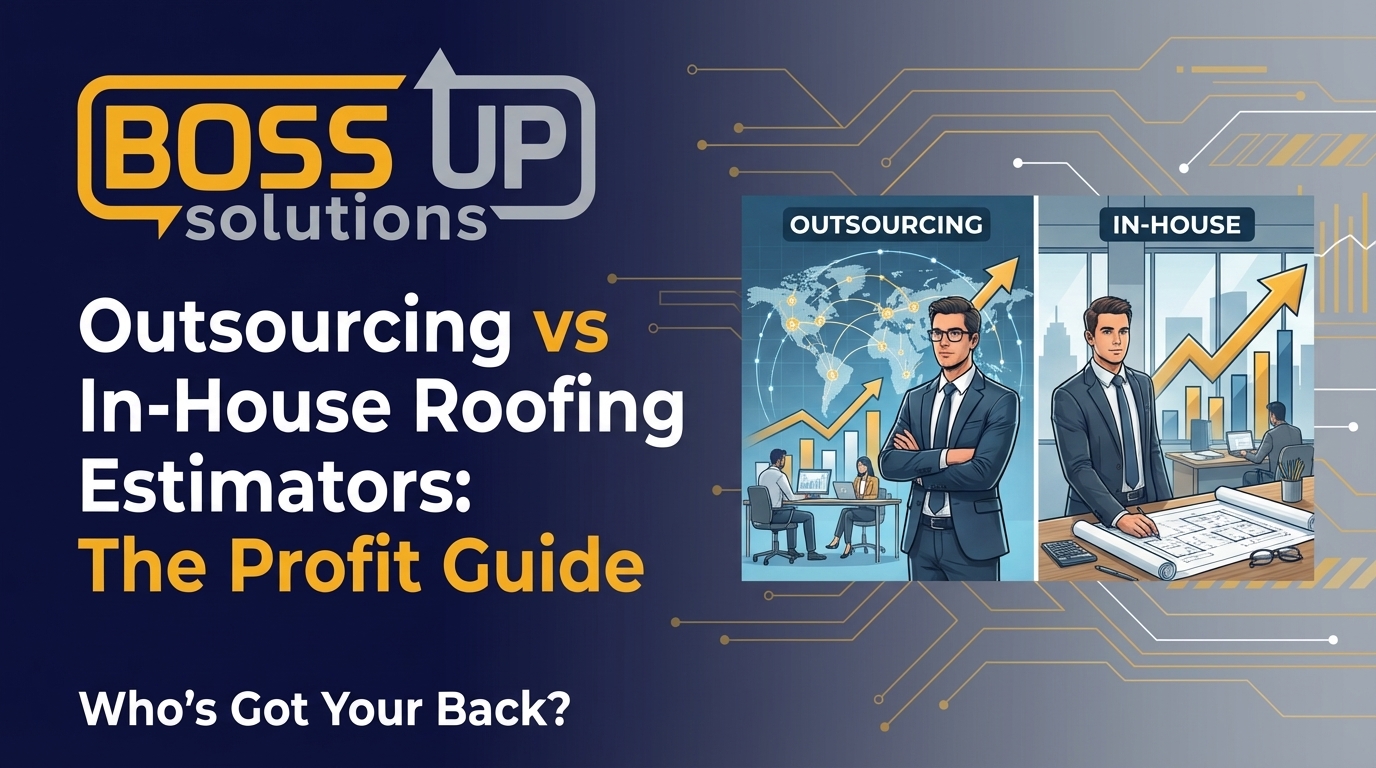
Outsourcing vs In-House Roofing Estimators: The Profit Guide
You are at a crossroads. Your roofing business is growing, leads are pouring in during storm season, and your current estimating workflow is becoming the bottleneck. Do you hire a full-time estimator and take on the salary burden, or do you partner with an outsourced estimating service to handle the volume?
It is the classic "Growth vs. Control" dilemma. Make the wrong choice, and you are either burning cash on payroll during slow months or losing bids because you can't get estimates out fast enough.
Quick Answer: Outsourcing vs. In-House Estimating
The choice between outsourcing and hiring in-house roofing estimators depends on your volume consistency. In-house estimators offer greater control and brand alignment but come with high fixed overhead and limited scalability during storm surges. Outsourcing provides flexible, per-project costs and instant scalability, making it ideal for handling peak seasons, managing insurance supplements, and minimizing overhead risk.
Introduction: The Roofing Estimator Dilemma (Growth vs. Control)
In the roofing industry, feast or famine is real. During a major storm event or the peak summer rush, you might need three full-time estimators just to keep up with leads. In the dead of winter? Those same estimators might be sitting on their hands while burning a hole in your payroll.
This volatility makes the decision to hire internally risky. A full-time employee offers dedication and an intimate knowledge of your company culture. However, they are a fixed cost in a variable revenue industry. On the flip side, outsourcing promises the "on-demand" flexibility that modern contractors crave, but it raises valid concerns about accuracy and quality control.
To Boss Up your business, you need to look at the numbers, the logistics, and the long-term scalability of both models.
Cost Analysis: The Real Price of a Full-Time Roofing Estimator vs. Outsourcing Services
Most contractors underestimate the true cost of an in-house hire. It is never just the salary. When you factor in the "hidden" costs of employment, the price tag balloons significantly compared to the flat-fee structure of outsourcing.
| Cost Category | In-House Estimator (Annual) | Outsourced Service (Per Project) |
|---|---|---|
| Base Salary / Fee | $65,000 - $90,000+ | Pay-per-estimate (Variable) |
| Taxes & Benefits (20-30%) | $15,000 - $25,000 | $0 |
| Software (Xactimate, CRM) | $3,000 - $5,000 | Included in fee |
| Training & Onboarding | $5,000+ (Time cost) | $0 |
| Total Liability | ~$100,000 Fixed | 100% Variable |
With outsourcing, you convert fixed overhead into a Cost of Goods Sold (COGS). If you have zero jobs, you pay zero dollars. This financial agility is critical for surviving the off-season without dipping into your reserves.
The Control Factor: Accuracy, Brand Standards, and Crew Nuances
The strongest argument for in-house estimating is control. An internal employee knows that your crew tends to use more ice-and-water shield than the code requires, or that you prefer a specific brand of flashing that costs 10% more.
The "Sales Handoff" Friction
In many smaller roofing companies, the estimator is also the salesperson. They walk the roof, shake the homeowner's hand, and write the estimate. Breaking this chain by outsourcing can create friction if not managed correctly. If you outsource, your sales team must be trained to trust the numbers provided by the remote team and understand how to present them.
Production Feedback Loops
A risk with outsourcing is the disconnect between "estimated" and "actual" costs. An in-house estimator hears about it immediately if they short the material order. To mitigate this with an outsourced partner, you must establish a feedback loop. Using services like Xact360 ensures you are working with professionals who understand production realities, not just data entry clerks.
Speed & Scalability: Handling Storm Surges and Seasonal Peaks
When a hailstorm hits your service area, speed is the name of the game. The first contractor to submit a professional, defensible estimate often wins the job.
An in-house estimator has a hard cap on their capacity—perhaps 3 to 5 comprehensive estimates a day. Once they hit that limit, your lead times stretch from days to weeks. Outsourced teams operate on a different scale. Because they distribute work across a team of experts, they can absorb massive spikes in volume without compromising turnaround time.
Scalability Check: If you land a commercial project or a 50-roof subdivision tomorrow, can your internal team handle the takeoff? If not, you are leaving massive revenue on the table.
Technology Gap: Aerial Measurements and Software Access
Roofing technology is evolving rapidly. Staying current with the latest Xactimate price lists, aerial measurement integrations (EagleView, Roofr), and CRM tools is a full-time job in itself.
Outsourced firms specialize in this tech. They often have:
- Enterprise-level subscriptions to Xactimate and Symbility.
- Integrations for importing aerial measurements directly into estimates.
- Designated experts for specific line items (e.g., code upgrades, O&P).
The Local Nuance Risk: One potential downside of outsourcing is missing local code requirements. However, top-tier partners (like Boss Up Solutions) utilize geolocation data and updated code databases to ensure your estimates account for regional specifics, such as wind-driven rain requirements in Florida or ice damming codes in Minnesota.
The Hybrid Approach: Keeping Sales Estimates In-House vs. Outsourcing Supplements
You do not have to choose 100% one way or the other. The most successful scaling roofing companies use a Hybrid Model.
In this model, your internal sales team handles the "Retail" estimates—the straightforward roof replacements where customer relationship is key. Meanwhile, you outsource the complex, time-consuming tasks that clog up their workflow:
- Xactimate Estimates: For insurance claims where line-item accuracy is non-negotiable.
- Supplementing: The tedious back-and-forth with adjusters to get paid for missed items.
- Commercial Takeoffs: Large, complex measurements that require specialized software.
This allows your sales team to do what they do best—sell—while a partner like Boss Up handles the technical heavy lifting involved in supplementing strategy.
Key Decision Matrix: When to Outsource and When to Hire Internally
Still on the fence? Use this matrix to determine the right move for your current business stage.
- Hire In-House If:
- You have consistent, year-round volume (10+ leads/week consistently).
- Your estimation process is highly customized and deviates significantly from industry standards.
- You need someone physically present to visit sites and manage crews.
- Outsource If:
- Your volume is seasonal or storm-dependent.
- You want to eliminate fixed payroll and switch to a variable cost model.
- You need specialized Xactimate expertise for insurance claims but don't want to pay a $90k salary for it.
- You are tired of training new estimators only to have them leave for a competitor.
Conclusion: Making the Right Choice for Your Roofing Business Size
Ultimately, the decision comes down to your appetite for overhead risk versus your need for scalability. For most growing roofing companies, the overhead of a full-time, idle estimator is a profit killer. Outsourcing provides the agility to Boss Up your operations, handling 100 claims as easily as you handle 10.
Don't let your backlog become a graveyard for potential profits. Whether you need precise Xactimate estimates or a full-service team to handle your insurance supplements, the right partner can be the difference between a record-breaking year and burnout.
Ready to optimize your estimating process? Stop guessing and start scaling. Partner with Boss Up Solutions today and get the back-office support you need to dominate your market.